On set, makeup has a job most of us never ask of it. It has to look identical in hour nine as it did in hour one, under lights, in heat, across dozens of frames. There is no midday do-over when a scene has to cut together.
That pressure produces better habits. Professional artists solve shine differently to the rest of us, and almost none of it involves reaching for more product.
The rule on set is continuity
Continuity means the face cannot change. A cheek that was soft in the morning cannot be flat in the afternoon, because the shots have to cut together.
This changes the whole approach. Artists are not touching up in the way most people think. They are maintaining what already exists, removing what has arrived, and adding as little as possible.
Everything in the kit is chosen against that standard. If a tool changes the finish, it does not get used mid shoot.

What is actually in the kit
Tools that remove, not tools that cover
The first response to shine on a professional set is removal. Oil is lifted off the surface before anything is considered as a top up.
This is the step most people skip entirely at home. Powder goes straight on top of the oil, and the problem gets buried instead of solved.
A very small amount of powder
Powder exists in every kit, but it is used sparingly and precisely. A small brush, a specific area, and a pressing motion rather than a sweep.
Under strong lighting, heavy powder can read as flat or chalky on camera. That risk keeps professional application light.
Sponges and brushes used to press
Sweeping moves product around. Pressing keeps it where it was placed. Almost every touch up motion in a professional kit is a press.
A compact, reusable oil absorbing tool
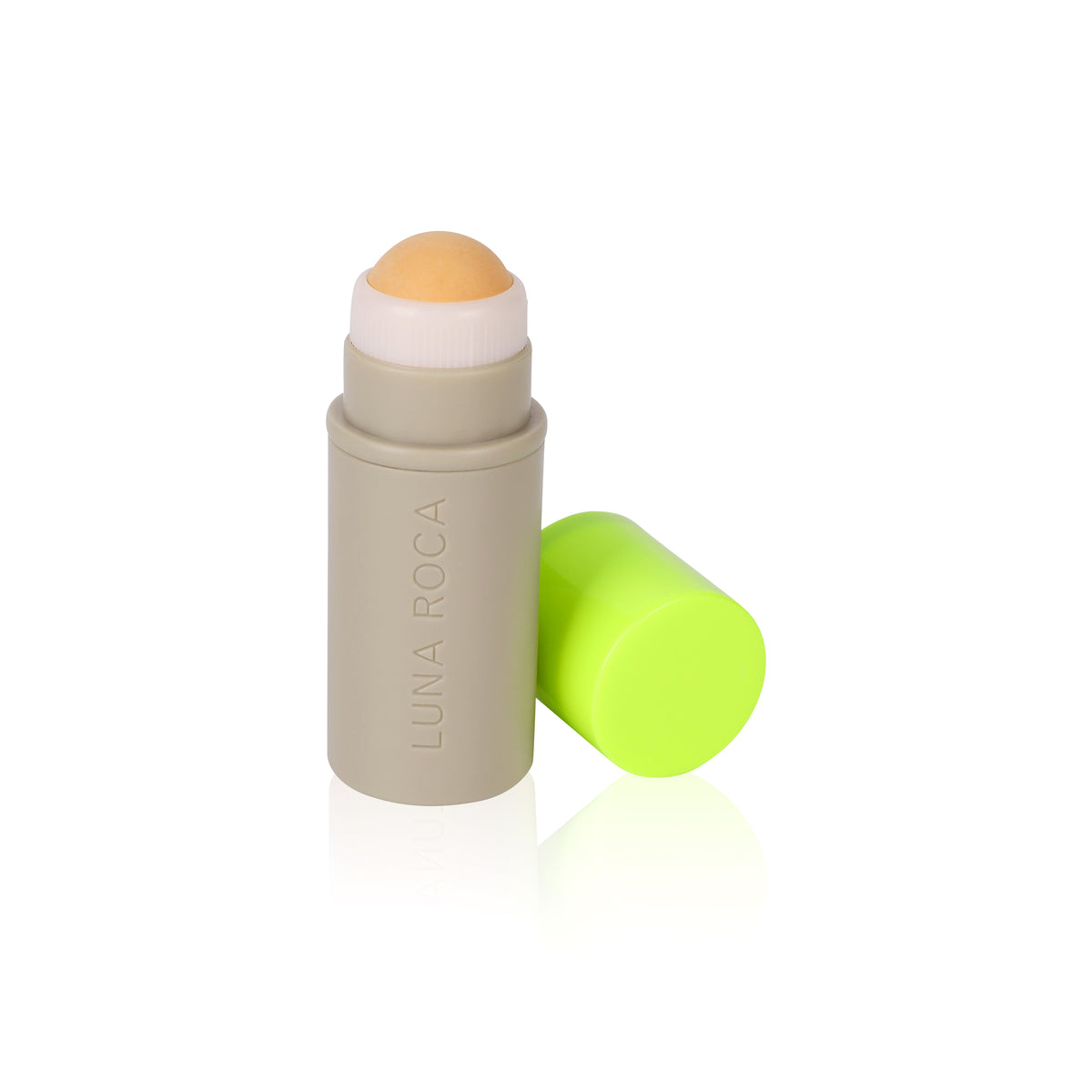
Kits are heavy and days are long, so anything that earns space has to be small, hygienic, and reusable. A volcanic stone roller fits that brief.
It works over a full face of makeup, produces no powder cloud near a camera or a black wardrobe rail, and does not need replacing halfway through a job.
The Rock & Roller was built around that use case, and it took bronze for Best Beauty Tools at the Get The Gloss Beauty Awards 2025.

Why powder is the last resort, not the first
Powder does absorb oil. It also sits on top of the makeup, and every application adds another layer.
By the third touch up, that layer has thickness. Texture shows around the nose, fine lines catch the product, and the finish stops looking like skin. It is the same failure point covered in the real reason blotting papers are a waste of money, just reached from a different direction.
Professional artists know they will need to touch up repeatedly across a long day. That knowledge is exactly why they start with removal instead.
Hygiene is a working requirement
A professional kit moves between faces, which makes cleanliness a practical concern rather than a preference.
Anything that cannot be cleaned properly either gets used once or gets left behind. That is why disposables still exist in kits, and why reusable tools have to be genuinely washable to earn a place.
A volcanic stone rinses under warm water in seconds and air dries between uses. Simple to clean is not a small feature on a twelve hour day.

What long days teach you about quantity
The clearest lesson from a professional set is how little product a long wearing face actually needs.
Thin layers survive. Thick ones break apart, and once they do there is no quiet way to fix them mid shoot.
It is the same principle that makes a nine to six day work at a desk or a full evening out. Less at the start means less to manage later, whether the finish you are protecting is matte, dewy, or somewhere in between, as covered in dewy vs matte for oily skin.
What you can borrow from a pro kit
- Maintain rather than reapply. Work with what is already on your face.
- Remove the oil first. Adding anything on top of shine makes it worse.
- Press, do not sweep. Movement is what breaks a base down.
- Keep powder small and specific. A little, in one area, with intention.
- Choose tools you can clean and keep. Hygiene matters more the more you use something.
The takeaway
A professional kit is not a longer list of products. It is a shorter list of better decisions, tested across days that run far longer than yours.
The most useful habit to steal is the simplest one. When shine appears, take it away rather than covering it up. Everything after that is easier. Shop the Rock & Roller.
FAQ
How do makeup artists control shine on set?
They remove oil before adding anything. On a professional set the priority is continuity, so the face has to look the same all day. Artists lift surface oil first, then use a very small amount of powder in specific areas if it is needed at all.
Why do professional artists avoid using a lot of powder?
Powder sits on top of the makeup and builds with every application. Across a long day of repeated touch ups it creates visible texture, and under strong lighting a heavy layer can read as flat or chalky on camera.
What tools do makeup artists use for touch ups?
Tools that remove rather than cover, small brushes and sponges used with a pressing motion, minimal powder, and compact reusable oil absorbing tools. Anything that changes the finish mid shoot is avoided.
Is a volcanic stone roller suitable for professional makeup kits?
Yes. It is compact, reusable, and works over a full face of makeup without creating powder fallout near a camera. The Luna Roca Rock & Roller was designed for on set touch ups and took bronze for Best Beauty Tools at the Get The Gloss Beauty Awards 2025.