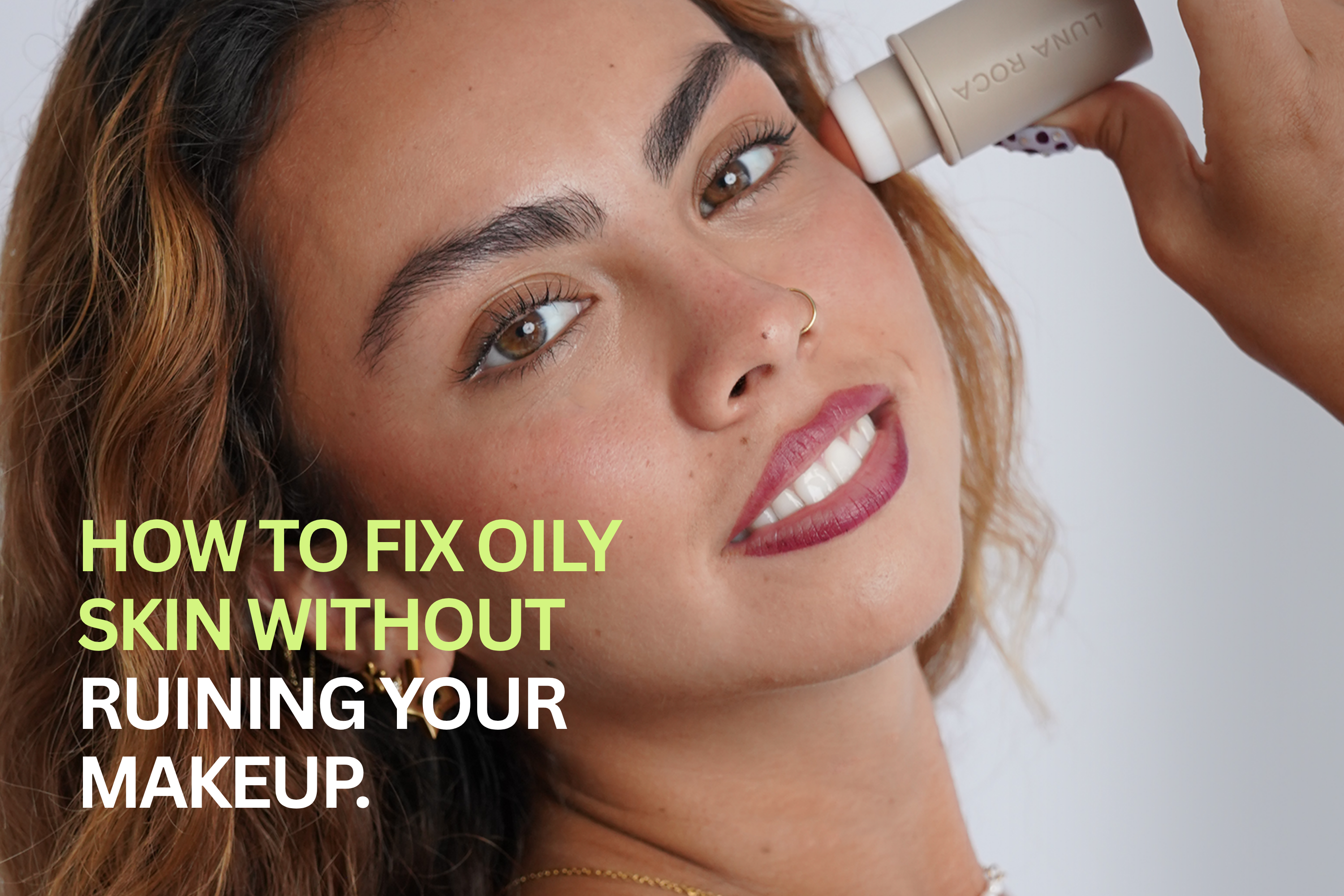
The problem is not the oil. The problem is what you do about it. Press powder over a full face of makeup and you end up with a patchy, cakey finish that looks worse than the shine did. There is a better approach.
Why the usual fixes make it worse
Setting powder re-applies product on top of product. By application three it looks heavy. Blotting papers work but can pull at makeup if not applied carefully. Touch-up foundation adds another layer. Setting spray is preventative and does not remove oil that is already on the surface.
The pattern: most fixes add to the skin rather than removing what is there. The Rock and Roller does the opposite.
The right way to remove shine mid-day
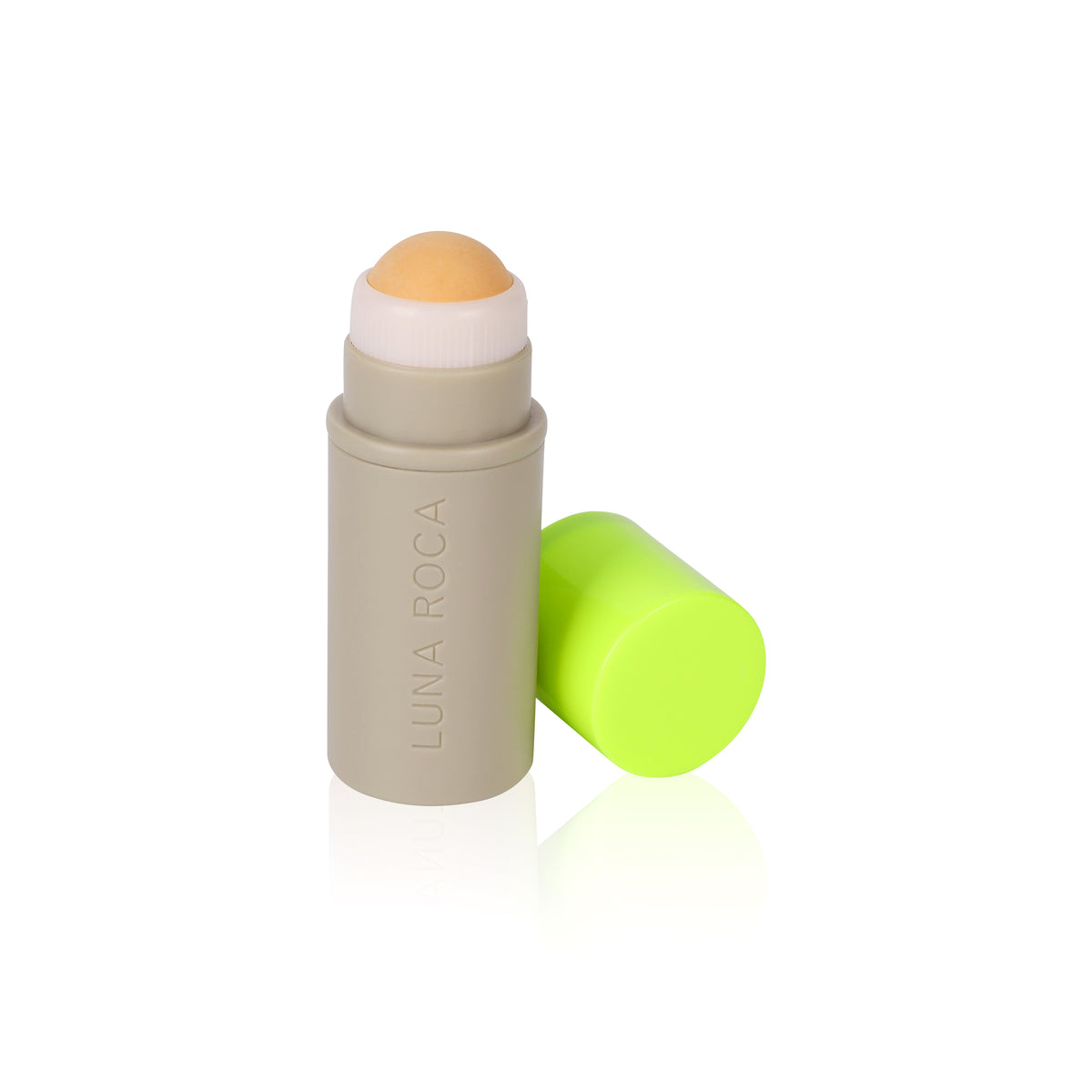
The Luna Roca Rock and Roller uses 100% natural volcanic lava stone to absorb oil on contact. Roll it lightly over the forehead, nose, and chin. It lifts excess oil without touching the makeup underneath. No pressure, no friction, no disruption. The makeup stays exactly where it was. The oil is gone.
Where to use it (and where not to)
Use it on the T-zone, which produces the most oil for most people. Forehead, nose, and chin. Some people use it across the cheeks too. Avoid the eye area. No prep needed. Roll it on over a full face of makeup, rinse it when you are done, and leave it to dry.
Making it part of your routine
The Rock and Roller lives in your bag. It weighs almost nothing. Pull it out before a meeting, before a photo, before a night out. Fifteen seconds. The result is a clean matte finish without the risk of disturbing what you have already applied.
Who What Wear called it the tool that now lives permanently in their editor's work bag. That is the exact use case.
FAQ
Can I fix oily skin without removing my foundation?
Yes. The Rock and Roller removes oil from the surface without disturbing the makeup underneath.
What is the best product to control oil without ruining makeup?
A volcanic stone roller like the Luna Roca Rock and Roller. It absorbs oil without adding product or disturbing your base.
How do I stop my face from getting shiny mid-day?
Use an oil-absorbing tool to remove excess sebum as it builds. Unlike powders, it does not create build-up over multiple uses.
Does blotting ruin makeup?
Standard blotting papers can disturb makeup at the edges. A volcanic stone roller does not. The porous surface lifts oil without friction against the skin.
Luna Roca Journal
How to Depuff Your Face in the Morning: 7 Gentle Methods
Waking up with a little facial puffiness is common. A cool compress, light massage, and a few small adjustments can help the face look and feel more refreshed without turning the morning into a complicated routine.
Why can your face look puffy in the morning?
Temporary morning puffiness can have several triggers, including sleep position, crying, seasonal allergies, a salty evening meal, alcohol, or simply spending hours lying flat. The delicate area around the eyes tends to make small changes in fluid especially visible.
Not every swollen face is ordinary morning puffiness. Dental infections, medication reactions, sinus problems, skin infections, and allergic reactions can also cause facial swelling.
When to seek medical help
Contact a healthcare professional if swelling is sudden, painful, one-sided, worsening, accompanied by fever or skin tenderness, or lasts more than a few days. Facial, tongue, or throat swelling with difficulty breathing or swallowing requires urgent medical care.
Use light pressure. More force does not create a better result.
7 gentle ways to reduce morning puffiness
Method 1
Apply a cool compress
Place a clean, cool washcloth over the puffy area for a few minutes. Cooling temporarily narrows blood vessels and can help reduce visible swelling, especially around the eyes.
Avoid placing bare ice directly on the skin. Stop if the area becomes uncomfortable or numb.
Best for: A quick, low-effort morning reset
Method 2
Use a light facial massage or roller
Gentle, one-directional movement may help shift temporary fluid and relax facial tension. Start around the neck with very light pressure, then move from the centre of the face outwards. Avoid repeatedly rolling back and forth.
The Luna Roca Rock & Roller adds a second function: its porous volcanic stone picks up excess surface oil while it rolls. Use it clean and dry, with light pressure, and avoid broken or irritated skin.
Best for: Light massage with simultaneous shine control
Method 3
Keep your head slightly elevated
If morning puffiness happens regularly, a slightly elevated sleeping position may reduce fluid collecting around the face. Add comfortable support rather than stacking pillows so high that it disrupts sleep or strains the neck.
Best for: Puffiness that appears after lying flat overnight
Method 4
Rehydrate gently
Start the morning with water and return to your normal hydration routine. There is no need to force excessive amounts at once. If congestion or a dry environment is involved, steady hydration may also help you feel more comfortable.
Best for: Mornings after travel, heat, alcohol, or low fluid intake
Method 5
Notice evening salt and alcohol
Some people notice more puffiness after salty food or alcohol. Rather than following a rigid rule, observe the pattern and moderate the triggers that consistently affect you. Avoid making sudden restrictive dietary changes for occasional puffiness.
Best for: Preventing a familiar next-morning pattern
Method 6
Address known allergy triggers
Seasonal allergies can make the eye area look swollen and irritated. Limit exposure to known triggers and follow the treatment plan recommended by your pharmacist or healthcare professional. Do not self-treat unexplained facial swelling as an allergy.
Best for: Puffiness that appears with familiar seasonal allergy symptoms
Method 7
Add a little morning movement
A short walk or gentle stretching helps the body transition out of sleep and supports general circulation. It is not a targeted treatment for facial swelling, but it can be a useful part of a calmer, more energising morning routine.
Best for: A whole-body morning reset
Face roller vs gua sha vs cool compress
These options do not perform exactly the same job. Choose according to the result you want, the time you have, and how sensitive your skin feels that morning.
Option
Main function
Preparation
Oil control
Makeup-friendly
Volcanic roller
Light rolling and surface-oil absorption
Use clean and dry
Yes
Yes, with light pressure
Smooth face roller
Cooling or light facial massage
Optional chilling
No
Sometimes
Gua sha
Manual facial massage
Usually needs slip from skincare
No
No
Cool compress
Temporary cooling and visible swelling relief
Cool clean cloth
No
No
For a wider look at tools that manage shine, read our guide to the best tools for oily skin.
A simple five-minute morning routine
1
Cool for one minute
Hold a clean, cool washcloth over the areas that look puffy. Keep the temperature comfortable.
2
Roll lightly for two minutes
On clean, dry skin, roll gently from the centre of the face outwards. Use extra-light pressure around the eyes and never roll over irritated skin.
3
Apply simple skincare
Follow with the products your skin already tolerates, then finish with SPF. Morning puffiness is not the time to experiment with a new active.
4
Clean the tool
Remove the volcanic stone, rinse it as directed, gently tap it dry, and allow it to air-dry completely before reassembling.
Frequently asked questions
How quickly can morning puffiness improve?
Mild temporary puffiness may settle gradually after you get upright and begin moving. A cool compress or gentle massage may make it look less noticeable, but results and timing vary.
Can a face roller permanently change my face shape?
No. A roller may temporarily reduce the look of puffiness and provide a light massage, but it cannot permanently sculpt bone structure or remove facial fat.
Can I use the Rock & Roller over makeup?
Yes. Use light pressure and roll rather than rub. The volcanic stone is designed to pick up excess oil without adding powder. Learn more about how volcanic face rollers work.
When is facial puffiness a medical concern?
Seek medical advice for swelling that is unexplained, persistent, sudden, painful, one-sided, or accompanied by fever, skin changes, dental pain, or eye pain. Difficulty breathing or swallowing requires urgent care.
A simple reset for puffiness and shine
The Luna Roca Rock & Roller combines a light rolling motion with natural volcanic stone that absorbs excess surface oil. It is compact, washable, refillable, and designed for quick everyday touch-ups.
Explore the Rock & Roller
Luna Roca Journal
Moon Phase Skincare: How to Build a Lunar Beauty Ritual
A moon phase skincare routine is less about asking the moon to transform your skin and more about creating a rhythm you can maintain. Each phase becomes a prompt to check in, adjust what you need, and avoid doing everything at once.
What moon phase skincare really means
Lunar calendars have long been used to mark time, ritual, and renewal. In a modern beauty routine, the moon can work as a simple monthly framework: reset, build consistency, observe, then simplify.
There is no strong clinical evidence that a particular moon phase changes how skincare ingredients perform. The practical benefit comes from regular check-ins. A repeating structure can help you avoid overusing actives, notice changes in your skin, and give recovery the same attention as treatment.
The simple version
Keep your daily essentials consistent, especially gentle cleansing, moisturiser, and SPF. Use the lunar phases as reminders to review your routine, not as strict biological rules.
The most effective ritual is the one that stays simple enough to repeat.
A four-phase lunar skincare routine
Each moon phase lasts roughly one week. The routines below are flexible prompts, so adjust them to your skin, your existing products, and any guidance from your dermatologist.
Phase 1
New moon: reset and review
Use the beginning of the cycle to look at what is working. Clean brushes and tools, check expiry dates, and simplify any routine that has become crowded.
Morning: Gentle cleanser, moisturiser, SPF
Evening: Cleanser, hydrating serum, moisturiser
Focus: Reset the routine before adding anything new
Phase 2
Waxing moon: hydrate and build
Make consistency the priority. If your skin already tolerates ingredients such as vitamin C, hyaluronic acid, or peptides, this phase can be a reminder to use them steadily rather than adding more.
Morning: Cleanser, chosen serum, moisturiser, SPF
Evening: Cleanser, hydrating serum, moisturiser
Focus: Hydration and repetition
Phase 3
Full moon: observe and balance
Pause before changing the routine. Notice shine, dryness, sensitivity, or congestion, then respond only to what is actually present. For midday oil, use a targeted tool instead of layering more product.
Morning: Gentle cleanser, light moisturiser, SPF
Evening: Cleanser, familiar treatment if tolerated, moisturiser
Tool: Use a clean volcanic stone roller for excess surface oil
Phase 4
Waning moon: simplify and recover
Finish the cycle with fewer steps. If skin feels dry or reactive, pause optional exfoliation and focus on gentle cleansing, hydration, and barrier-supportive moisturiser.
Morning: Water or gentle cleanser, moisturiser, SPF
Evening: Gentle cleanser, calming serum, moisturiser
Focus: Comfort, recovery, and preparation for the next cycle
Where the Rock & Roller fits
The Luna Roca Rock & Roller has one clear skincare role: its porous volcanic stone picks up excess surface oil. Use it on bare skin or over makeup when shine appears, especially through the T-zone.
The rolling motion also offers a light facial massage, but the tool should not be used to push serum deeper into the skin. Apply skincare as usual, allow it to settle, and use the roller separately when oil control is needed.
Use For visible surface oil and on-the-go touch-ups
Pressure Keep it light and avoid rubbing the skin
Care Rinse the stone and let it air-dry completely
For a closer comparison with blotting paper and powder, read our guide to the best tools for oily skin.
How to track the cycle without overcomplicating it
Use the moon calendar already built into many weather or calendar apps, or add four repeating reminders to your phone. At each phase, write down one observation about your skin and one adjustment, if any.
After one or two cycles, the useful information will not be whether the moon caused a change. It will be which products feel comfortable, when you tend to over-exfoliate, and what your skin looks like when the routine stays consistent.
Keep the basics steady
Do not rotate essential products purely for the sake of the calendar. Daily SPF, gentle cleansing, and a suitable moisturiser matter more than following every phase perfectly.
Does moon phase skincare actually work?
There is no established evidence that moon phases directly change the effectiveness of skincare. What can work is the structure: regular observation, fewer impulsive product changes, planned recovery time, and more consistent care.
Think of the lunar cycle as a thoughtful calendar rather than a treatment. If you experience persistent acne, irritation, pigmentation, or another ongoing concern, a qualified dermatologist can help build a routine around your skin rather than the moon.
Frequently asked questions
Can the moon directly affect my skin?
There is no strong clinical evidence that a moon phase directly changes skin behaviour or makes ingredients work differently. The cycle can still be useful as a regular reminder to observe and adjust your routine.
Do I need different products for every phase?
No. Keep your core routine stable. The phase prompts are designed to change your focus, such as hydration or recovery, without requiring a completely different shelf of products.
Can I use a volcanic face roller every day?
You can use a clean volcanic roller when excess oil appears, provided your skin is comfortable and you use light pressure. Avoid broken or irritated areas and stop if the skin becomes sensitive.
How is a volcanic roller different from a jade roller?
Jade rollers have a smooth surface and are mainly used for a cooling facial massage. Volcanic stone has a porous surface designed to collect excess oil. Learn more in our guide to how volcanic face rollers work.
One simple tool, whenever shine appears
The Luna Roca Rock & Roller uses natural volcanic stone to absorb excess surface oil without adding powder or disrupting makeup. It is compact, washable, refillable, and designed for real life.
Explore the Rock & Roller
Luna Roca Journal
Volcanic Face Rollers: Do They Actually Work?
Volcanic face rollers promise a quick answer to midday shine. The idea is simple: roll the stone over skin, lift excess oil, and leave makeup in place. Here is how the tool works, where it fits into a routine, and what to expect from it.
What is a volcanic face roller?
A volcanic face roller is an oil-control beauty tool made with natural volcanic stone. Its porous surface picks up excess oil from the skin as it rolls, helping to reduce visible shine without adding powder or another layer of product.
It serves a different purpose from a jade or rose quartz roller. Those smooth stones are typically used for cooling and facial massage. A volcanic roller is designed first for practical shine control, with the rolling action also supporting a light de-puffing massage.
Why volcanic stone?
Volcanic stone forms as lava cools, leaving a naturally porous texture. That surface can collect excess oil on contact. The result is immediate and physical, with no powder, mist, or disposable sheet added to the skin.
Use gentle pressure and let the volcanic stone make contact with the areas where shine appears.
What does it actually do?
The main benefit is straightforward: it removes excess surface oil when and where you need it. The format also makes it useful beyond the bathroom shelf.
Controls visible shine. Roll it across the forehead, nose, chin, or cheeks for a fast matte refresh.
Works over makeup. Used with light pressure, the stone absorbs oil without adding another layer over foundation or concealer.
Supports a de-puffing massage. Rolling from the centre of the face outwards creates a gentle massage that can support lymphatic movement.
Reduces single-use waste. The stone can be washed, air-dried, and used again, making it a practical alternative to disposable blotting paper.
Travels easily. The compact format fits into a work bag, makeup kit, or carry-on for touch-ups between plans.
Volcanic roller vs blotting paper vs powder
All three can reduce visible shine, but they do it in different ways. The most useful option depends on whether you want to remove oil, add coverage, or keep your routine reusable.
Feature
Volcanic roller
Blotting paper
Mattifying powder
Approach
Picks up excess surface oil
Presses away surface oil
Adds product to reduce visible shine
Over makeup
Designed for gentle rolling
Can shift makeup if rubbed
Can build up after repeated layers
Reusable
Yes, washable and refillable
No, usually single-use
No, requires replacement
Best for
Fast, mess-free touch-ups
Occasional disposable touch-ups
Extra coverage or setting makeup
For a wider look at everyday oil-control options, read our guide to the best tools for oily skin.
How to use a volcanic face roller
1
Start where shine appears
Use the roller on bare skin or over makeup, focusing on the forehead, nose, chin, and cheeks.
2
Roll gently outwards
Move from the centre of the face outwards using light, even pressure. There is no need to press hard.
3
Refresh as needed
Keep it nearby for midday shine, post-commute touch-ups, long workdays, or a quick reset before going out.
4
Clean and air-dry
Twist to unlock and remove the stone. Rinse it under warm water, gently tap it dry with a clean towel, and let it air-dry completely before returning it to the case.
Who is it best for?
A volcanic roller is especially useful for oily and combination skin, or for anyone who regularly reaches for blotting sheets and powder during the day. It also suits makeup wearers who want to reduce shine without repeatedly layering product.
The compact format works well for commuters, travellers, makeup artists, and anyone who prefers a fast touch-up to a full skincare reset. For sensitive skin, use very light pressure, keep the stone clean, and avoid rolling over broken or irritated areas.
Frequently asked questions
Do volcanic face rollers really work?
Yes, they can remove excess surface oil and reduce visible shine. They do not change how much oil the skin produces or treat acne. The Luna Roca Rock & Roller was awarded Bronze for Best Beauty Tool at the Get The Gloss Beauty Awards 2025.
Can I use one over makeup?
Yes. Roll gently rather than rubbing. This allows the stone to collect oil while helping foundation, concealer, and setting products stay in place.
How long does a volcanic roller last?
With regular cleaning and proper drying, a quality stone can support months of regular use. The Luna Roca design is refillable, so the stone can be replaced when needed.
Is it suitable for sensitive skin?
Many people with sensitive skin can use a volcanic roller, but pressure and hygiene matter. Start gently, keep the stone clean, and stop if the skin feels irritated.
How is it different from a jade roller?
A jade roller has a smooth surface and is mainly used for a cooling facial massage. Volcanic stone has a porous surface designed to collect excess oil, so shine control is its primary function.
A practical reset for midday shine
The Luna Roca Rock & Roller uses natural volcanic stone to absorb excess oil without adding powder or disrupting makeup. It is compact, washable, refillable, and designed for everyday use.
Explore the Rock & Roller
Looking for more reusable swaps? Read the best reusable beauty tools worth the investment.